
A decade ago, I was told there was a vaccine available at almost half its usual price, and that it was a vaccine for prevention of cervical cancer. I had probably only one or two years of studying medicine behind me at that point, so I knew vaccines were important, but I definitely didn’t understand HPV and its importance the way I do today. I remember asking my parents for the money, and their reaction was, “We have given you all the vaccines you needed to take, what is this new one?” They didn’t think it was necessary, mostly because they didn’t really understand what it was for. Maybe it was a language barrier, maybe a knowledge barrier, or maybe it was simply something that wasn’t being spoken about enough at that time. I am still not completely sure. But I took it, partly because it was available at half the price, which even then was still in thousands — and today, I am genuinely glad I did.
We as humans are constantly trying to find ways to prevent diseases and avoid things that can harm us as much as possible. I think the years of COVID made us understand this in a way perhaps nothing else could. We saw shortages of medicines and healthcare, we saw people desperately trying to find remdesivir, steroids and anything else that might help their patients or their loved ones, even while we were still learning about the disease and how much each treatment could actually help. And when the vaccine became available, despite all the questions and uncertainties that naturally came with something new, we wanted it, because we had seen what the disease could do. We understood the value of prevention because we had seen the consequences of not having it. And that is what made me wonder — the HPV vaccine has been around for almost two decades, so how is it that even today, so many people still don’t know about it?
Whenever a young girl, a woman or a couple would come to my OPD and I would suggest the HPV vaccine, I would get so many questions in return. “What is that?” “Who is it for?” “My child is only 12, why does she need it?” “But she isn’t sexually active.” “If it is for cervical cancer prevention, why should my son take it?” “Isn’t it too expensive?” “Is there any alternative?” “I am in my postpartum period, can I take it?” “We have done things, but I have never had sex, can I still get infected?” “I have a son, he doesn’t need it, right?” And there I would sit and explain, because for many of them this was the first time anyone had actually spoken to them about it. Sometimes, after explaining everything, I would tell them that I had taken the vaccine too, and the response would be, “Oh okay, then it must be genuine.” And then came even more questions. It always made me realise that sometimes people don’t need a complicated medical lecture; sometimes they simply need someone they trust to start the conversation.
There was another conversation that stayed with me for a completely different reason. A woman with advanced cervical cancer once came to the OPD and was understandably devastated about her situation. At one point she asked me, “Ma’am, is there nothing we could have done to prevent this or cure this?” After telling her option for treatment, when we spoke about prevention and I mentioned the HPV vaccine, her immediate question was, “Can my granddaughter take it?” I remember that because we often understand the importance of prevention most deeply only after we have seen what a disease can do. We understand it when it happens to us, or to someone we love. But perhaps we don’t always have to wait until then.
I am not here to tell you what HPV is, what every type of HPV does, how exactly it causes cellular changes or which vaccine contains which particular strain. There is enough information available online and in books for anyone who wants to go into those details. What I really want to talk about is something much simpler- why are we still so uncomfortable talking about this vaccine?
Maybe it is because HPV is associated with sexual contact. And the moment we hear that, the conversation becomes uncomfortable. We start thinking about our children, about whether they are “too young”, about what the vaccine means, about whether our sons need it, about whether we ourselves have already been exposed to it. But a vaccine is a preventive measure; it is not a judgement about someone’s character, morality, relationship or sexual life. HPV is simply a very common virus, and most infections are cleared by the body’s immune system. The problem is that some infections persist, and persistent infection with certain high-risk HPV types can, over years, contribute to cancers including cervical, anal, vulval, vaginal, penile and throat cancers. Some types can also cause genital warts.
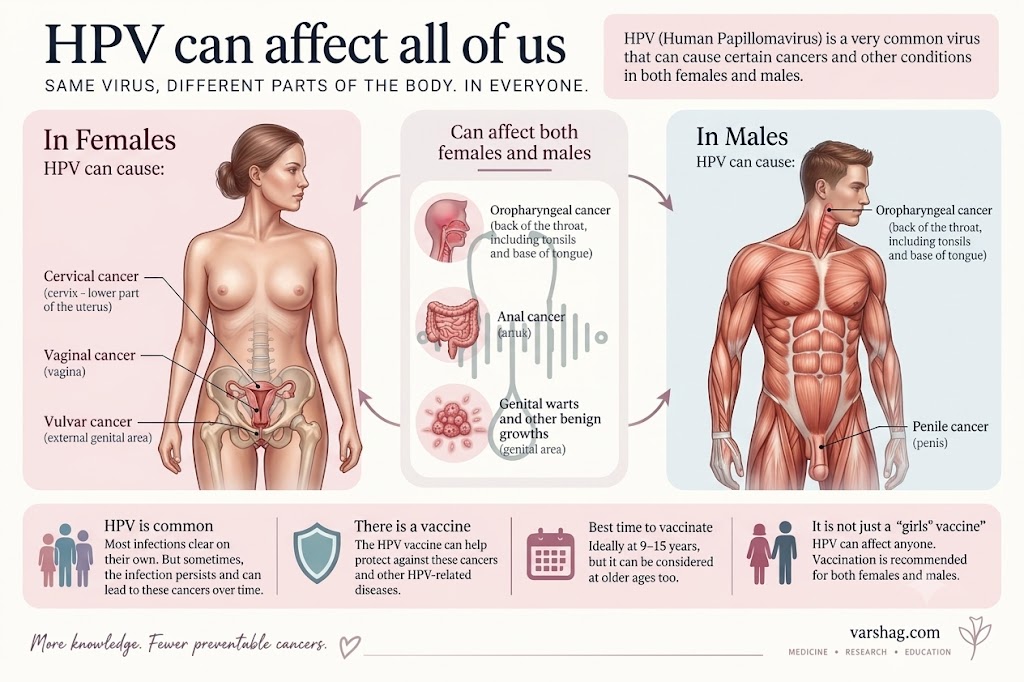
And perhaps this is why the vaccine is recommended at a younger age. Not because we expect a 9, 10 or 12 year old to be sexually active, but because prevention works best before exposure. We vaccinate before something happens, not after. That is the whole idea of a vaccine.
And no, this isn’t only a girl’s vaccine. HPV can affect men too, and HPV-related disease includes cancers of the penis, anus and throat as well. So when someone asks me, “Why should my son take it if it is for cervical cancer?”, the answer is simply that HPV is not a virus that chooses gender.
If you are already an adult, the answer becomes a little more individual. The greatest benefit is before exposure, which is why vaccination is prioritised in younger ages. But being older does not automatically mean there is no possible benefit. Vaccination is routinely recommended through age 26 for those who were not adequately vaccinated earlier, while for adults between 27 and 45, it can be considered after an individual discussion with a healthcare professional. The vaccine prevents new HPV infections; it does not treat an infection that is already present.
India has also finally started talking about HPV vaccination much more actively. This year, the Government of India launched a nationwide programme providing free, voluntary single dose of quadrivalent vaccination to eligible 14 year old girls at government health facilities, with parental consent. By September 2026, more than 80 lakh doses had already been administered through the campaign.
I think that is an important step, especially because one of the biggest problems with prevention is that people cannot choose something they don’t even know exists. But the government programme has a specific target group; it doesn’t mean that HPV vaccination is only for 14 year old girls, nor does it mean that everyone outside that age group automatically needs it. If you fall outside the programme, it is something you can discuss individually with your doctor to get more clarity.
I also don’t want this article to make anyone feel that they have somehow failed because they didn’t get you the vaccine earlier. Most of us simply weren’t told enough about it. I wasn’t. My parents weren’t. Many people from their generation weren’t. It doesn’t make sense to blame ourselves for something we didn’t know. But once we know something, perhaps we can make a different decision for ourselves, and perhaps we can make sure our partners, our brothers and sisters, our sons and daughters or our closed ones doesn’t miss the conversation.
And that is really all I wanted to say.
Not that you should take it because I am telling you to.
Not that every person needs the same vaccine or the same number of doses.
Just that you should know it exists.
You should know that HPV is something we can prevent against, that the vaccine is not something to be embarrassed about, and that if you have a question, you should be able to ask it without feeling judged.
You may have missed the conversation when you were younger.
But perhaps someone else doesn’t have to.
If you have questions about HPV or the HPV vaccine, whether for yourself, your child, your partner or someone you love, you can always write to me. I would be happy to help you understand it.