
It sounds so abstract and so random at this point. But this was exactly a sentence I once told one of my friends at one of their lowest points in life. I wanted her to understand what things are in reality and at that time, I thought I understood what those words meant.
But it totally changed when I heard this from someone else telling me.
I was going through a big, life-changing decision, and I was having difficulty making it. I hadn’t had my food for over 22 hours by then, and a dear friend told me, “Life does cease once you die. Respect your body, go eat.” And somehow, the words once you die came out differently this time. It made me think even more, and a whole new point opened up in my head. All the things which I think I knew subconsciously suddenly came out.
I think there are mainly two points of view.
When you die, life does cease to exist. You are dead. That’s it. No one really has any clue about what happens to life after death. We have all heard different things; we have our own beliefs, but the truth is, we don’t really know.
When I die, my life is over. I don’t know what is happening around me. I don’t know who is sitting beside me, who is crying, who is remembering me or what is happening in the world. The body has no life in it, and for that person, life has ceased.
But then I started thinking about the other side of it.
Does life really cease when someone dies around you?
That is where it becomes so different, right?
A dear one has passed away, and yes, that person’s life has ceased. They are gone. They have no idea what is happening around them anymore. But what about the person who is experiencing that loss? Are they feeling the same thing?
When someone else’s life ceases
A few years ago, I had to declare someone dead. Soon after that, when I went to meet the family, I overheard the family discussing something. The person was dead, but they were already discussing what would happen to that person’s husband and whether he could eventually be married again, even within their own family.
And I remember thinking, how can someone think about getting married when their wife is lying dead right in front of them?
But then, perhaps, that is how life is.
For the person who had died, life had already ceased. But it had not ceased for the people outside. They still had to live. They still had to make decisions. They still had to wake up the next morning and figure out what to do with their own lives.
Some people try to move on years later. Some struggle for years just to even think about moving on. Some people move on within a fraction of a second. We may not understand it, and sometimes we may even find it difficult to accept, but eventually, life continues for the living.
And perhaps – it is about us. It is about the living in the end.
What do we do with the life they left behind?
But I don’t think continuing to live means leaving someone behind.
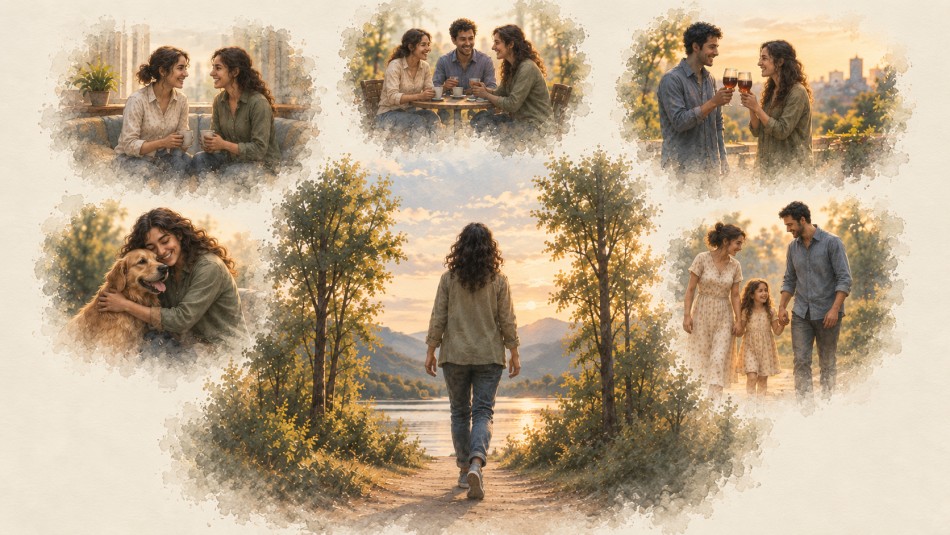
We continue to live after someone’s death through all the good times we had with them. We have the memories, the conversations, the things they taught us, the places we went together, the silly things that made us laugh, the difficult times we went through together. All of that is still ours.
Their life may have ceased, but the part of their life that they shared with us hasn’t suddenly disappeared.
We should be able to enjoy those memories. We should be able to talk about them, laugh about them, miss them and still continue to live. Being happy after someone dies does not mean that we loved them any less. Enjoying something they are no longer here to enjoy does not mean that we have forgotten them.
Perhaps, in some way, they continue to live through the good they brought into our lives and through the person they helped us become.
And sometimes, someone leaves without dying
Maybe this thought isn’t only about death.
People leave our lives in many different ways. Sometimes they die. Sometimes they become sick. Sometimes they move away. Sometimes relationships end. Sometimes someone who was once the most important person in our life becomes someone who is no longer a part of our everyday life.
Even then, does everything that person gave us have to disappear? I don’t think so.
Someone can have been an amazing part of my life. They can have given me so much, helped me grow, taught me something about myself, been there for me during some of the most important moments of my life and contributed to the person I am today. And even if that person is no longer in my life, I don’t think I need to erase all of that.
We can enjoy what we are and how that other person contributed to the good in us.
We can be grateful that they were a part of our life without needing them to remain there forever.
Sometimes, a person can be an important part of our story without being the person who stays until the end.
And then there is another kind of difficulty — when someone we love is still alive but very sick.
How do we deal with happiness in our own life when someone that close to us is not well? Do we change? Do we have to change?
When I know that someone close to me is sick, when I know that someone might not become better, or that they might not come back, how am I supposed to react?
Do I stop enjoying a friend’s birthday party? Do I stop going on another trip? Do I stop enjoying a child having fun? Do I stop having a simple sweet because the person I dearly love is not able to have it? How long do we not enjoy the happiness that comes our way simply because someone else whom we love is in extreme pain or sadness?
There are so many questions.
And yes, grief is so different for every kind of illness, every kind of sick person around you, and every kind of death or loss. There is no fixed amount of time for any of it. Some people may need days, some years, and some may always carry a certain amount of sadness with them.
But at some point, we also have to ask ourselves- how long do we stop living our own life?
Being a doctor doesn’t make us any less human
This is something that has bothered me personally, and being a doctor has made me think about it from both sides. I also resonate with many other doctors who feel the same way.
When I know someone is sick, my mind immediately goes to, “Okay, I’m a doctor. What is the solution? What are the other options? What do I need to discuss with another doctor? What are the treatment options? What is the next best step? Which hospital is best for them? What do I need to discuss with the treating doctor?”
Yes, that is a part of who I am. But that is not all I am.
I am also someone to that person, and that person is someone to me too.
Despite doing my part as a doctor and as someone close to them, I also grieve. I also become sad. I also worry. I also become scared. And perhaps that is something I have had to understand again and again — being a doctor does not make us any less human.
At the end of the day, we are humans, just like any other person. Be it a doctor, an engineer, a child, an elderly person or anyone else, we all experience the same emotions in different ways.
We may understand the medical part of what is happening, but that doesn’t mean we understand how to deal with the emotional part of it any better.
Are we allowed to live?
I don’t think anyone can tell another person how long they should grieve or how quickly they should move on. Being sad is a natural part of any grief process.
But I also think that at some point, we need to understand that there is a life just for us too.
That person had their own happiness. That person had their own life. They may have sacrificed so many things to be in our life or to give us what we have today. But if that person loved us, and if we loved that person so much, would that person really want us to be suffering with this too?
Similarly, our own body doesn’t want that much of suffering either.
I’m not saying today. I’m not saying tomorrow. I’m not saying years. That is different for every individual. I am only saying that at some point, we need to understand that there is a life that we have to figure out for ourselves too.
From the time we are born until the time we are dead, there is something in between. Whether it is real, whether it is not, whether we understand it or not — we are still living it. And living is the reality.
If we want to live through the sadness, if we want to live through the grief for a long time, that is up to us. But nobody should make us feel that we are not grieving properly because we smiled one day, went out with friends, enjoyed a meal or laughed at something.
We are sad for them, but we also don’t want to keep hurting ourselves.
And perhaps that is where we find that middle line.
The life that remains
Maybe we don’t have to choose between remembering someone and living our own life.
We can do both.
We can allow those memories to stay without allowing the loss to consume everything that comes after it.
Dear ones may no longer be a part of our present, but that doesn’t mean their contribution to our past has to be erased.
They were something to us, and we were something to them too.
And perhaps we should make it a point to remain that something to someone, or to ourselves at least, in the end. We should respect what we are. We should respect our body, our growth, our education, the people who love us and the fact that we are also needed by someone. We should enjoy the fact that we are alive and that there are still things left for us to experience.
Because life ceases when we are dead.
But life does not cease when someone else dies.
And while we are still here, perhaps we have to be what we have to be, live what we have to live, and carry forward all the good that people have left in us — until life ceases for us.